 kgeographer Karl Grossner, PhD
TeachSpatial: Resources for Spatial Thinking and Learning
Screenshots
Organization
Center for Spatial Studies at the University of California Santa Barbara
Roles
Grant co-author; Platform design; Principal Developer; Research Lead
Technologies
OAI-PMH; NSDL Search API; Python; conceptual modeling; controlled vocabularies; metadata harvesting; Drupal (portal implementation)
Description
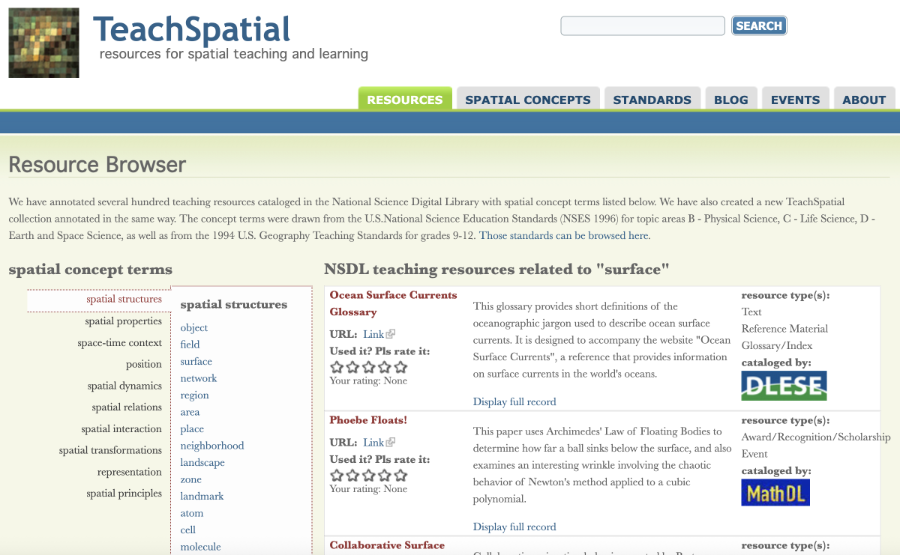
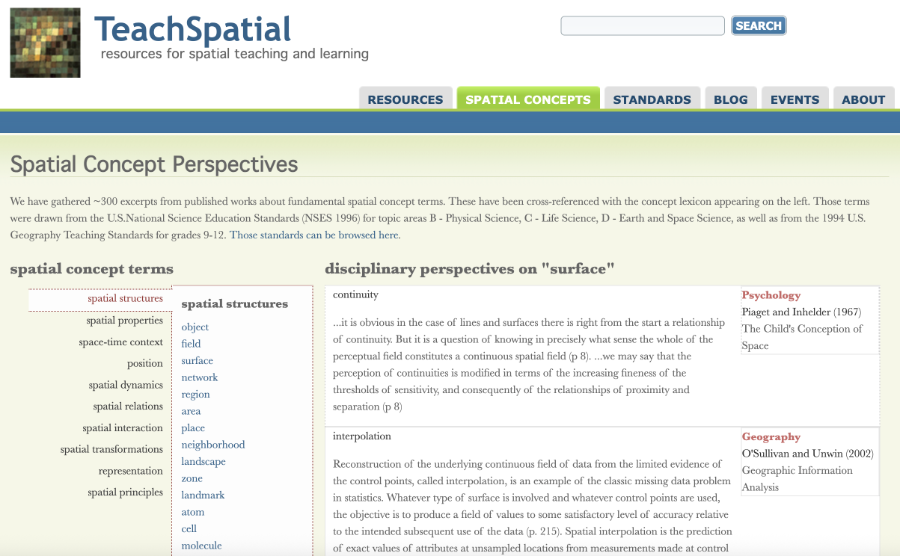
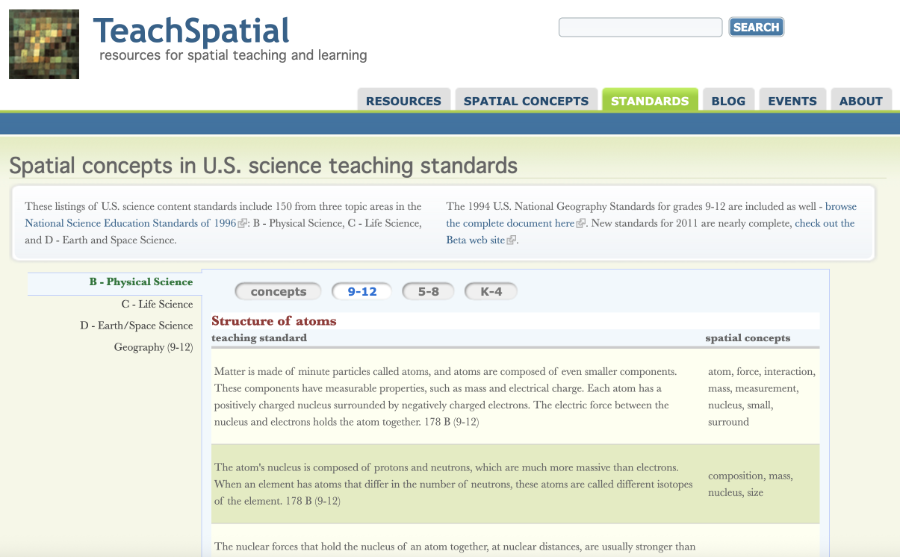
TeachSpatial was an NSF-funded initiative at UCSB aimed at strengthening spatial thinking and reasoning education across STEM and the social science subjects. PI Donald Janelle and I designed the conceptual and technical foundation of the project during its original development phase. We led a small working group in extracting spatial concepts embedded implicitly within the AAAS Benchmarks for Science Literacy. This analysis produced a controlled vocabulary of spatial constructs, ranging from geometric and topological ideas to spatial cognition, representation, and reasoning processes.
Building on this vocabulary, I designed and implemented a harvesting pipeline for the National Science Digital Library (NSDL) learning resource repository. At the time, NSDL exposed a machine-readable metadata infrastructure through the OAI-PMH protocol along with its REST-based NSDL Search API. Using these interfaces, I developed a system that automatically retrieved, classified, and indexed NSDL learning resources associated with any spatial concept identified in our Benchmarks analysis. The system supported both harvesting and contribution of metadata records to the NSDL Metadata Repository, effectively creating an enriched subset of spatial-thinking educational resources and demonstrating the pervasive role of spatial reasoning in existing STEM curricula.
The resulting TeachSpatial portal combined conceptual modeling, metadata integration, and web application development into a single platform. It served as an early demonstration of how structured vocabularies and harvesting pipelines can support spatial thinking research and instruction, anticipating later work in digital humanities infrastructure, semantic modeling, and spatial knowledge organization.